


Peter Westley
SEEC Lab PI
Peter is a life-long Alaskan. He obtained BS and MS degrees in Aquatic and Fishery Sciences at the University of Washington and a PhD at Memorial University of Newfoundland. He is fascinated by the patterns of fish diversity in nature and explores the ecological and evolutionary underpinnings of those patterns. By using examples from colonization, hatchery wild salmon interactions, invasion, and climate change he and his students explore the causes and consequences of fine scale adaptive change in salmonid and other freshwater fishes. Contact Peter at pwestley at alaska.edu; 907-474-7458 or swing by his office in 204 Arctic Health.

Scott Chandler
PhD candidate
Scott joined the lab in spring of 2024 after finishing his MS in Wildlife Biology and Conservation at UAF, advised by Dr. Greg Breed. He likes to pair quantitative methods with the life history traits of species and populations to answer questions of conservation concern. Scott is currently studying how contemporary changes in body size at age interact with environmental variation to result in disastrously low adult abundance of sockeye salmon in Chignik, Alaska. This work is done in partnership with the Alaska Department of Fish and Game and the Chignik Intertribal Coalition to improve the resiliency of communities in this remote, special, and dynamic region of Alaska.

Roberto Ponce Velez
MS candidate
Roberto joined the lab in fall 2025 as a MS student and is part of the Evolving Metaecosystem (EvoME) Institute. He is studying the effects of genetics and environment across populations of Arctic Grayling (Thymallus arcticus) in Arctic Alaska. By comparing the growth and development reaction norms across populations distributed along a latitudinal gradient, his study aims to understand the role of plasticity and local adaptations in response to changing environmental conditions across Arctic Ecosystems. Out of the office, Roberto is a staunch fly-fisher and community member. His free time is spent thinking about future fishing trips and how to bring people together, either with a rod or plate of food in hand. He thinks music, art, and lifting weights is cool too.

Benjamin Rich
MS graduate 2024
Ben joined the lab in Spring 2021 and is studying the bioenergetics of Northern Pike in Southcentral Alaska in cooperation with the US Fish and Wildlife Service. The pike in the photo is the fish that started his project and remains the largest pike he's ever seen.

Dr. Krista Oke
Postdoc 2021
Krista joined the lab in 2018 as a Centennial Postdoc working on an NCEAS State of Alaska Salmon and People (SASAP) working group project synthesizing patterns, causes, and consequences of body size declines in Alaska salmon. She is currently focused on walleye pollock, investigating the impacts of recent exceptionally warm temperatures in the Bering Sea on pollock body size and local abundances. Krista is broadly interested in evolutionary ecology and has ongoing field projects following experimental stickleback populations in Southcentral Alaska.

Marta Ulaski
MS graduate
For her thesis, Marta quantified the strength and form of selection acting on body size of smolt sockeye salmon on Kodiak Island. Was Yoda right? "Size matters not". Marta is currently pursuing a PhD in Fisheries Science at Simon Fraser University.

Joe Spencer
Undergraduate
Joe completed his undergraduate senior thesis in the spring of 2018 where he examined the diet and growth patterns in native and invasive northern pike. Pike love to eat fish...when they can! But they are just fine persisting on insects. They don't eat each other as much as you might have heard or thought.

Michelle Stratton
MS graduate
Is there really more to know about Buskin River adult coho salmon? As it turns out there is a ton! For her thesis, Michelle demonstrated the importance of holding habitat for fish prior to spawning, particularly Buskin Lake. Michelle is currently working as the Assistant Area Management Biologist for the Alaska Department of Fish and Game in Chignik, AK.

C. Nathan Cathcart
Nate worked in the SEEC Lab on a diet synthesis of northern pike across Alaska. Pike love to eat fish when they can, but can persist on insects and each other.

Julia McMahon
SEEC Lab Manager
Julia is a lifelong Alaskan and graduated from the SEEC Lab in 2021 with a MS in Fisheries. Julia researched straying, a fundamental aspect of salmon biology that ensures the continuation of salmon. Her research quantified and compared return timing, length, instream lifespan, and other life-history traits of stray hatchery and homing wild salmon on the spawning grounds of Prince William Sound, Alaska. Currently, she runs day-to-day operations at the lab which includes everything from running boats and doing helicopter surveys to cleaning gear and writing contracts and papers.
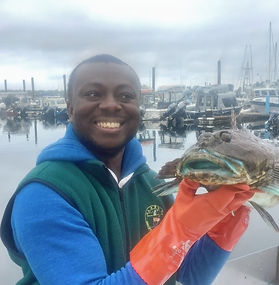
Isaac Nyameke
PhD candidate
Isaac joined the lab in Fall 2022. His research focuses on quantifying long-term trends in body size and age of Southeast Alaska sport-caught black rockfish (Sebastes melanops) across nine coastal communities and evaluating their stock status using data-limited assessment models to understand how the population is growing, reproducing, and responding to fishing pressure and climate change. Isaac’s research is part of the Alaska Department of Fish and Game’s Statewide Rockfish Initiative (SRI).

Eugene Peltola III
MS candidate
Eugene joined the SEEC Lab in the fall of 2022 as a Tamamta Fellow. His current work is focusing on Eulachon in Southeast Alaska, attempting to shed more light on their mysterious life history. Specifically looking at their potential for repeat spawning, do they only spawn once or can they spawn multiple times? Eugene has worked with the Chilkoot Indian Association for the past few spring field seasons on their Eulachon Population Monitoring project.

Dr. Sam May
Postdoc 2023
Sam joined the lab in Winter 2022 as a CICOES Postdoc. His current work focuses on using quantitative genetic simulation models and empirical pedigree datasets to investigate the effects of pink salmon hatcheries on natural population recruitment and resilience in Prince William Sound, AK. Sam is broadly interested in how behavior, life history diversity, and human impacts can influence population recruitment and resilience in wild populations. Prior to joining the lab, Sam completed his Ph.D. at the University of Washington. He also runs GetMeToGrad.com, a website aimed at helping students navigate the overwhelming graduate school admissions process.

Molly Payne
MS graduate
Molly joined the SEEC lab in the fall of 2019 to better understand the factors that make some rivers more attractive to hatchery strays than other rivers in Southeast Alaska. Molly received the prestigious DIPAC Graduate Fellowship. After graduating, Molly landed an excellent fisheries job with a Fairbanks based consulting company.

Chase Jalbert
MS graduate
In every invasion there is a silver lining. Chase explored the population structure of introduced northern pike using ddRAD sequencing approaches and conducted the first watershed risk analysis to guide conservation and suppression efforts to the on-going pike invasion. Chase currently works as a project leader at the Alaska Department of Fish and Game Gene Conservation Lab.

Morgan Sparks
MS graduate
For his MS thesis in the SEEC Lab, Morgan quantified the potential adaptive response of Bristol Bay sockeye salmon to warming water temperatures during spawning and embryo development. He is currently working with Mark Christie's group at Purdue University.

Casey McConnell
MS graduate
Understanding the causes and consequences of straying by Pacific salmon is a fundamental and applied question. Casey tackled this by studying straying by hatchery produced chum salmon in Southeast, Alaska and showed that strays enter the spawning grounds later, live fewer days, retain more eggs, are younger and smaller than wild counterparts. He also showed that stress was not obviously linked to straying, though did find that hatchery fish had higher rates of vaterite in their otoliths than wild fish. Casey is currently a small business owner in Hoonah, AK.

Cynthia Nelson
Undergraduate
Cynthia completed an independent project on the antipredator behavior of juvenile salmonids in Interior and Southcentral regions of Alaska in the context of the northern pike invasion. Her work was supported by an award from URSA at UAF

Elizabeth Lindley
PhD candidate
Elizabeth is studying Pacific salmon in the Arctic with a specific focus on the potential for salmon to successfully spawn in Arctic freshwater systems, and how Arctic thermal regimes might influence timing of important life events (phenology) during incubation. Through collaboration with the Department of Fisheries and Oceans Canada Arctic Salmon Project, Elizabeth is conducting a common garden experiment to quantify lower thermal limitations during incubation. She is also working closely with the Alaska Arctic Observatory and Knowledge Hub to track observations of unusual salmon occurrences in Alaskan Arctic coastal communities.

Leif 'Raven' Dawson
MS candidate
Raven joined the lab in Fall 2024 as a lab technician and transitioned to a MS in fall of 2025. His research focuses on understanding habitat use by Northern Pike and Chinook Salmon through a blend of Indigenous knowledge and western science. The goal of the project is to determine whether overlap in habitat use may limit or exclude Chinook salmon. When not working, Raven enjoys outdoor activities like climbing and hiking.

Keith Herron
MS graduate 2025
Keith is a Yup’ik biologist and scholar whose roots are in Bethel, Alaska. However, he grew up in Wrangell, Seward, and Kenai, Alaska. His research is a collaborative project with State, Federal, and Tribal partners investigating the impacts of Ichthyophonus on homeward migrating Yukon River Chinook Salmon. As well as pursuing his Master of Fisheries as a Tamamta program fellow, Keith is an Assistant Subsistence Fisheries Manager with USFWS, and a Tribal Liaison of Fisheries on the Yukon River. His goal is to proactively understand the impacts of Ichthyophonus disease in Chinook salmon for the benefit of the salmon and the people who rely on them. He hopes to uplift multiple ways of knowing (Indigenous, local, and western) surrounding overall salmon health and monitoring. He is honored to live and work on the traditional homelands of the lower Tanana and Dena’ peoples in Fairbanks, Alaska.

Madeline Lee
MS graduate 2023
Maddy joined the SEEC lab in the fall of 2020. After a record hot summer in 2019, Maddy noticed behavior of heat stress in Chinook salmon on the lower Cook Inlet salmon streams during her Alaska Department of Fish and Game technician position. Partnering with Woodwell Climate Research Center and United States Geological Survey, Maddy will be assessing the prevalence heat stress in spawning Chinook salmon and quantifying the link between Pacific salmon heat stress presence and spawning success in the subarctic.

Eric Walther
MS graduate 2021
Eric worked with the Washington Department of Fish and Wildlife to construct a watershed prioritization map for the Chehalis River in Southwest Washington State. Using extensive on-the-ground sampling, Eric built intrinsic potential models to assess fine scale habitat potential for coho salmon and steelhead. Eric is currently pursuing a PhD in Ecology at the University of Georgia.

Katja Berghaus
MS graduate
Invasive species are opportunities to explore phenotypic divergence to new habitats. Katja joined SEEC from Germany where she conducted research for her MS that explores contemporary trait change in northern pike introduced to Southcentral Alaska with comparisons to the native range. She is continuing on with a PhD at UAF under the supervision of Trent Sutton.

Madeline Jovanovich
Undergraduate
Madeline worked in the SEEC Lab on the large and ambitious 'State of Alaska Salmon & People' Project. During her time she worked to compile mountains of data on salmon escapement and harvest, hatchery release and return numbers, and in the process became a wiz at data science. She is a life long commercial fisher with roots in Washington State and heart in Bristol Bay.

Dr. Curry Cunningham
Postdoc
For his postdoc work, Curry formulated a novel stage-based life history model for Yukon River Chinook salmon and found evidence that climate in the ocean and freshwater, plus competition at sea with Asian stocks of chum salmon can explain patterns of survival. Dr. Cunningham is an assistant professor in the Department of Fisheries at UAF on the Juneau Campus.

Cara Koutchak Roberts
Undergraduate
Cara joined the lab in 2022 as an undergraduate student in Fisheries and has been an inspiration to work with. She is interested in connecting western science and indigenous knowledge.